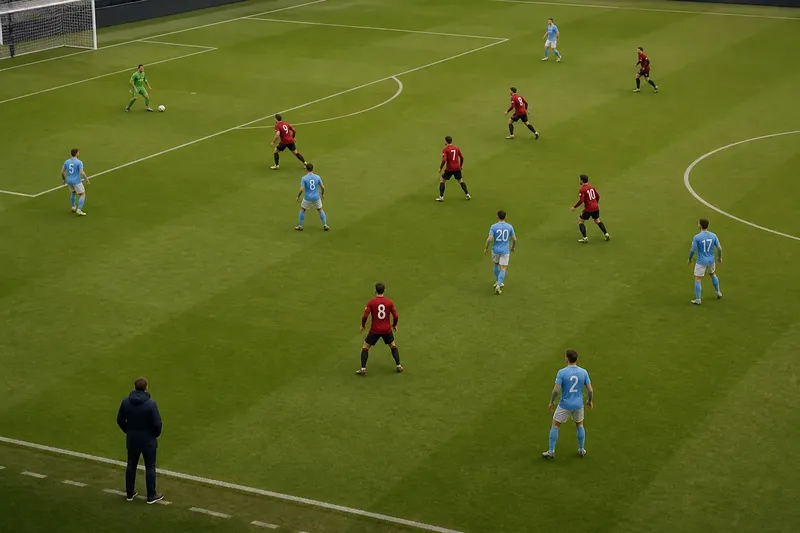
The Offside Line Moves with the Play
Football offside position is judged when a teammate plays the ball. Learn to spot the reference line, active involvement and the difference a defender’s touch makes.
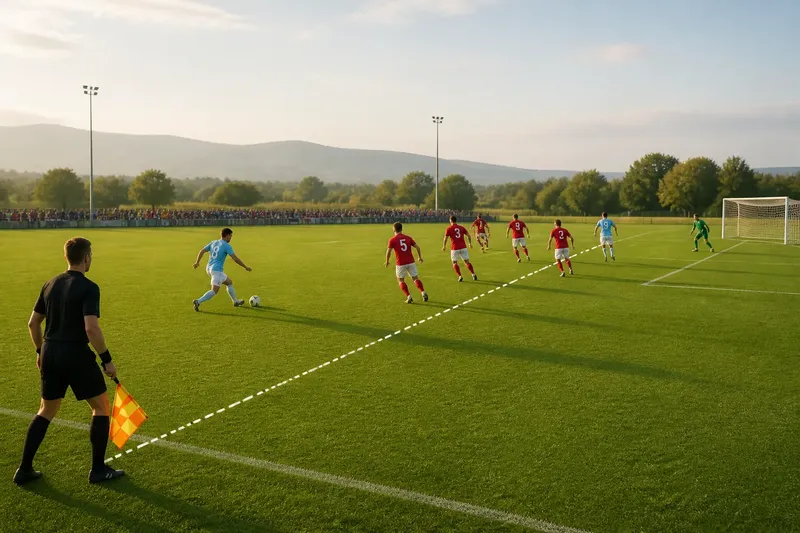
The most common offside mistake is judging the attacker’s position when the ball arrives instead of when a teammate plays it. That mistake can make a correct decision look arbitrary, especially when an attacker runs back toward the pass or a defender steps up. Football offside position is assessed at the instant a teammate plays or touches the ball; whether the player is penalized depends on what happens next.
Keep two questions separate: Was the player in an offside position at that instant? Did the player then become involved in active play in a way the rule penalizes? The answers explain why the apparent offside line moves with the action.
The relevant instant
The referee does not freeze the scene when the ball reaches the receiver. The key instant is when a teammate plays or touches the ball. An attacker who is level with the relevant opponents then may run beyond them to collect the pass without becoming offside merely because the run continues forward.
For a pass that takes time to travel, the receiver’s arrival position is not the starting test. Imagine a midfielder playing a forward pass while a striker is level with the second-last opponent. The striker accelerates into open space and receives the ball farther upfield. If the striker was not in an offside position at the instant of the pass, moving beyond the defenders afterward does not create one for that pass.
A later touch by a teammate can create a new reference instant. In a sequence of passes, identify the teammate’s touch that led to the involvement being judged rather than assuming the original pass remains the reference point.
The reference line
Offside position is judged in the opponents’ half, excluding the halfway line itself. A player level with the halfway line is not in an offside position on that basis. In the opponents’ half, compare the player’s eligible body parts with both the ball and the second-last opponent.
A player is in an offside position if any part of the head, body or feet is nearer to the opponents’ goal line than both the ball and the second-last opponent. Hands and arms do not count, including for the goalkeeper. The comparison concerns position, not whether the player is leaning forward, sprinting or standing still.
The second-last opponent is not automatically the goalkeeper. Often the goalkeeper is closest to the goal and an outfield defender is next, but positions can vary. If the goalkeeper has come out, the two opponents nearest the goal line determine the comparison.
“Level” matters. If an attacker’s eligible body parts are level with the second-last opponent, the attacker is not in an offside position. The same is true if the attacker is level with the ball.
Position and offence
Being in an offside position is not itself an offence. A teammate can play the ball toward a player beyond the defensive line, and play may continue if that player does not become involved in active play as the rule defines it.
Involvement can occur by playing or touching the ball. It can also occur without a touch: for example, by challenging an opponent for the ball or clearly obstructing an opponent’s line of vision. A player may also gain an advantage from an offside position by playing a ball that rebounds or is deflected to them from an opponent or the goal frame, subject to the rule’s distinctions.
Not every nearby attacker interferes. A player in an offside position who is not attempting to play the ball and does not affect an opponent’s ability to play it may not be penalized. The referee considers the player’s actions and their effect on play, not proximity alone.
Runs and moving lines
Attackers and defenders move in opposite directions to shape the line. A forward may time a run to start level and reach the ball beyond the defenders. Defenders may step forward together, leaving an attacker nearer the goal when the pass is played. The line is a momentary relationship among the ball, the attacker and the second-last opponent, not a fixed strip of turf.
As a viewer, track the potential receiver and the opponents nearest the goal, then locate the passer’s touch. If the receiver was level with or behind the relevant line at that instant, the subsequent run alone is not an offside offence.
Say you are watching a winger receive a pass while a striker waits beyond the defenders. If the striker stays out of the action and the winger carries the ball, the striker’s position alone does not stop play. If the winger then passes to the striker, judge the striker’s position again at that new teammate touch and consider whether the striker becomes involved.
Opponent touches
A defender’s contact with the ball does not always change the offside judgment. Under the current Laws of the Game, an attacker who was in an offside position may be treated as receiving the ball from an opponent’s deliberate play rather than from the earlier teammate’s play. A deflection or a save does not have that effect.
“Deliberate play” is not simply a matter of whether a defender touched the ball or had some possibility of controlling it. The referee assesses the action as a whole, including how the ball came to the opponent and what the opponent did. The Laws describe factors such as whether the ball travelled from a distance, its direction and speed, whether it was easy to see, and how much time the opponent had to coordinate their movements. No single factor decides the call.
For example, a defender who has time to see a pass and makes a purposeful attempt to play it may be judged to have deliberately played the ball, even if the attempt is poor. A defender who only reacts as the ball unexpectedly strikes them may have made a deflection instead. A goalkeeper’s save is not a deliberate play that resets offside. From a single camera angle, these distinctions can be hard to judge; avoid treating every contact as a reset.
Specific restarts
A player cannot be offside directly from a goal kick, throw-in or corner kick. If a teammate touches the ball afterward, ordinary offside judgments can apply to the next play.
A player in their own half cannot be in an offside position. If the player runs into the opponents’ half after a teammate has played the ball, use the player’s position at the teammate’s touch; crossing halfway during the ball’s travel does not retroactively change that position.
These exceptions change the starting point, not every later judgment. For competition-specific wording, consult the current Laws of the Game and the relevant competition guidance; youth and modified formats may have different rules.
Signals and video
An assistant referee’s flag indicates an offside offence, not merely that an attacker was standing beyond the defenders. The flag may be delayed while the attack develops, giving the referee a chance to see whether the player in an offside position becomes involved. In a close passage, wait for the decision rather than treating the flag as a judgment of position alone.
Video review may draw lines to compare players, but the image still depends on identifying the relevant touch and judging active involvement. Camera angles can also make a player appear ahead or level. The governing questions remain the player’s position at the teammate’s play and their subsequent role.
Questions about offside?
Does the attacker’s whole body have to be ahead?
No. Any eligible part of the head, body or feet can put the attacker nearer the goal line than both the ball and the second-last opponent. Hands and arms are excluded, and being level is not offside position.
Can a player run back to an onside ball?
Yes, if the player was not in an offside position when a teammate played the ball. Running back does not make the player offside; position is judged at the teammate’s touch, not at the receiver’s arrival.
Is a player penalized for standing offside?
Not for position alone. The player must become involved in active play in a way covered by the rule, such as playing the ball, affecting an opponent, or gaining an advantage from a rebound or deflection.
Does a defender’s touch reset offside?
Not always. A deliberate play by an opponent can change the judgment, but a deflection or save does not. The referee considers the nature of the action rather than treating any touch as decisive.
A quick viewing check
Use these observations to keep the two judgments separate. Each one points to a next action rather than asking you to decide from the final position alone.
- Check whether the potential receiver is in the opponents’ half at the teammate’s touch; if not, do not call an offside position on that basis, and move on to the next play.
- Check which two opponents are nearest their goal line at that instant; if the goalkeeper has moved out, use the two opponents who are actually nearest, and compare the attacker with them.
- Check whether any eligible part of the attacker is nearer the goal line than both the ball and the second-last opponent; if so, mark an offside position, but wait to see whether the player becomes involved.
- Check whether the player plays or touches the ball; if so, assess an offside offence, and if not, watch for an effect on an opponent.
- Check whether the player challenges an opponent or obstructs their line of vision; if so, consider interference, and if not, do not infer involvement from proximity alone.
- Check whether a later opponent contact was a deliberate play, a deflection or a save; if it was a deflection or save, retain the earlier offside question, and if it appears deliberate, consider the nature of the play before judging the attacker’s involvement.
Imagine a midfielder passes from the opponents’ half. At the instant of the pass, a striker is level with the second-last opponent, while a winger is beyond that opponent but does not challenge anyone or affect the goalkeeper’s view. The midfielder’s pass reaches the winger, who controls it and sends a new pass toward the striker. For the first pass, the striker’s level position is onside, while the winger’s position alone is not an offence because the winger has not yet interfered. At the winger’s later pass, judge the striker’s position afresh; if the striker is then beyond both the ball and the second-last opponent and plays the ball, the striker is penalized for becoming involved from an offside position. The sequence shows why each teammate touch can create a new judgment.
The phrase football offside position points to the first part of the decision, not the whole offence. Locate the teammate’s touch, compare the attacker with the ball and second-last opponent, then watch for involvement. For opponent contact, distinguish a deliberate play from a deflection or save rather than relying on the touch alone.