High Press or Mid-Block: Where Does the Defence Begin?
Learn how a high press differs from a mid-block, where each defense starts, and which player movements reveal how a team wants to defend.
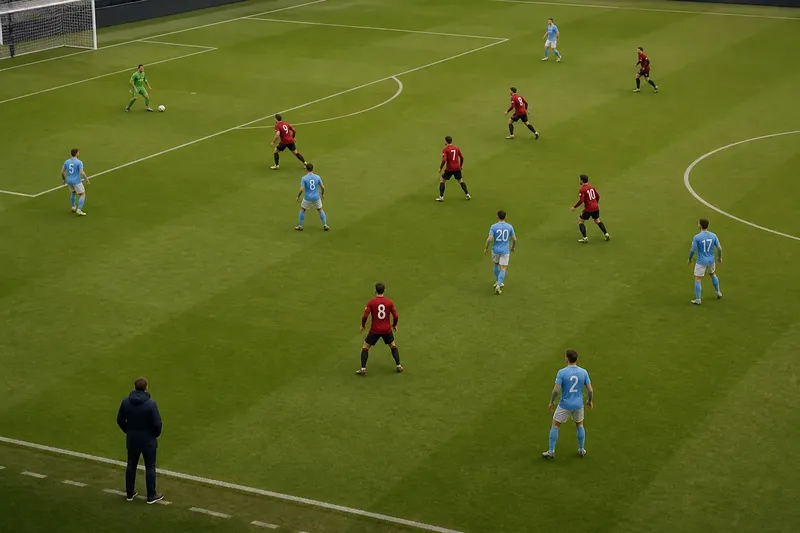
The common mistake in reading a high press is to watch only the player chasing the ball; the cost is missing the teammates who make that chase useful. A mid-block can look passive for the same reason: its defenders may be waiting for a cue, not simply retreating. To tell the systems apart, watch where the team first tries to restrict the opponent’s choices. That starting space is the heart of the high press versus mid-block comparison.
Where Does Each Defense Begin?
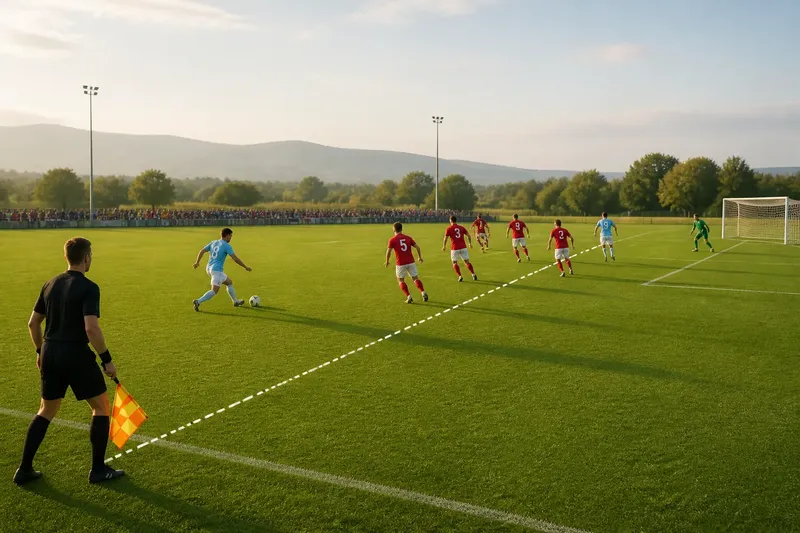
A high press begins close to the opponent’s goal, often as soon as a goalkeeper or center back receives the ball. The pressing team advances its forwards and midfielders to challenge the first pass or steer it toward a chosen side. The defensive line behind them moves up too, narrowing the space available between the lines.
A mid-block begins farther back, around the middle area of the field. Rather than chase every pass near the opponent’s goal, the team holds a compact shape and waits for the ball to enter its preferred area. Its forwards may still pressure the ball carrier, but the main intention is to keep the opponent in front of them and limit routes through midfield.
These names describe a team’s usual starting space, not a fixed position on the field. A side can press high after a goal kick, then settle into a mid-block once the opponent escapes. A mid-block can also step forward when a loose touch or sideways pass creates an opening.
What Is a High Press?
A high press is coordinated pressure on the opponent’s buildup near the opponent’s own goal. The nearest forward may close down a center back, while a teammate blocks the pass to the other center back or goalkeeper. Midfielders move close enough to challenge likely receivers, and defenders push up to reduce the space behind that group.
The important word is coordinated. If one player rushes forward while teammates stay deep, the opponent can pass around the isolated challenger. When the whole unit advances together, a defender receiving the ball may have fewer safe options. A hurried long pass, a backward pass, or a turnover can follow; none is automatic, but each is a result the press is designed to invite.
Watch the goalkeeper and center backs at the start of an attack. If the opposing forwards close them quickly and teammates step high to shadow nearby passing lanes, the defending side is trying to contest the buildup early. Notice, too, whether the pressure directs play toward a sideline. The boundary can reduce the ball carrier’s available passing angles, giving nearby defenders a chance to close in.
What Is a Mid-Block?
A mid-block is a compact defensive shape positioned between a high press and a deep defense near its own goal. The team gives the opponent some room to circulate the ball in safer areas, then tries to protect the central lanes and challenge passes into midfield or toward its defensive line.
Here, the first defender often delays rather than sprinting directly at the ball. The rest of the unit slides across together, keeping its lines close enough that a receiver between them has little time to turn. This can make the opponent pass sideways or play toward a crowded area. The defense is not necessarily trying to win the ball at the first opportunity; it is trying to make forward progress difficult.
For a viewer, look at the distance between the opponent’s midfielders and forwards. If the defending team remains compact in the middle while allowing center backs time on the ball, it is likely holding a mid-block. Pay attention to whether the defending forward screens a pass into the central midfielder instead of charging the passer. That positioning can be a more revealing signal than the forward’s speed.
How Can You Tell Them Apart?
Focus on the first few actions after the opponent gains settled possession. The ball’s location matters, but the defending team’s collective position matters more.
- Starting distance: Are several defenders already near the opponent’s penalty area, or are they gathered around midfield?
- Forward movement: Do forwards close down the goalkeeper and center backs, or keep their shape and screen passes into the middle?
- Midfield position: Do midfielders step up to challenge receivers near the back line, or hold a compact line farther away?
- Defensive line: Does the back line advance in support of pressure, or stay deeper behind the midfield block?
- Response to a backward pass: Does the whole unit accelerate toward the ball, or maintain its shape and wait for a clearer cue?
One movement alone can mislead. A forward may chase a center back as part of a team’s press, or simply try to slow play while the rest of the team stays in a mid-block. Read the nearby midfielders and defenders alongside the first challenger, then watch for the same pattern on the next buildup.
Why Choose One Approach?
A high press can disrupt an opponent before its attackers have moved into useful positions. Winning the ball near the opponent’s goal may create a short route toward a scoring chance. The trade-off is space behind the advancing defenders: if the opponent passes through the pressure, it may have room to attack quickly. The press also asks players to move together and recover if the first attempt is beaten.
A mid-block keeps more players between the ball and the defending team’s goal. That can make central routes harder to find and leave less space behind the defense than an aggressive press would. The trade-off is that the opponent may have time to pass across the back or advance into the middle third. The mid-block then depends on patience, compact spacing, and well-timed decisions about when to step forward.
Neither shape tells you which team is playing better on its own. A high press that is repeatedly passed through may be ineffective, while one that forces the opponent away from its preferred buildup can be doing its job without winning the ball. A mid-block that keeps the ball outside may be functioning as intended even if the opponent has more possession.
What Should You Watch For Next?
Does the press have a trigger?
A trigger is a moment that prompts several defenders to move together, such as a backward pass or a receiver controlling the ball poorly. Watch whether teammates react to the same cue or whether only the nearest player moves. A shared response suggests a planned press rather than an isolated chase.
Which passing lane is being blocked?
A defender’s position may make more sense when you look beyond the ball. A forward angling a run between the ball carrier and a central midfielder may be trying to discourage that pass while inviting a less dangerous route. The opponent’s available choices reveal what the defense is attempting to steer.
What happens after the first line is beaten?
If the opponent passes beyond the forwards, see whether the midfielders step toward the receiver or retreat into a compact shape. A high press can turn into a mid-block once its first wave is bypassed. The change tells you how the team protects itself after the initial plan meets resistance.
Is the defense moving as a unit?
When the ball travels from one side to the other, watch whether the whole block shifts across while keeping its spacing. If one line moves and another stays behind, gaps can open for a forward pass. The movement of the group is more informative than a defender’s position in isolation.
How Does the Shape Change?
Teams often alternate between approaches within a match. A side may press a goal kick, then drop once the opponent carries the ball past the first line. It may also press only after a pass toward a particular player or side, while keeping a mid-block at other times. Formation labels alone do not explain these choices: the same lineup can defend high or hold its ground depending on the plan and the moment.
Say you are watching a team whose forwards close down the opposing center backs after a goal kick. If the opponent passes into a midfielder and the defending team then retreats into a compact shape around the center of the field, you have seen a high press shift into a mid-block. The observable clue is not a change in personnel but a change in where the group chooses to engage.
It is not worth trying to name a new system every time one player steps out of position. For a useful read, track the team’s starting space, its response to a backward pass, and what it does when the first line is passed. Those cues make the high press versus mid-block distinction clear without turning every moment into a tactical puzzle.
The next time an opponent builds from the back, follow the defenders who are farthest from the ball as well as the closest challenger. Their position shows whether the team is trying to win possession near the opponent’s goal or contain the attack around midfield—and whether its shape changes when the buildup advances.