Round-Robin Groups and Knockout Brackets, Compared
Round-robin groups vs knockout brackets: see which format rewards consistency, which turns each match into a survival test, and how to read the route to a champion.
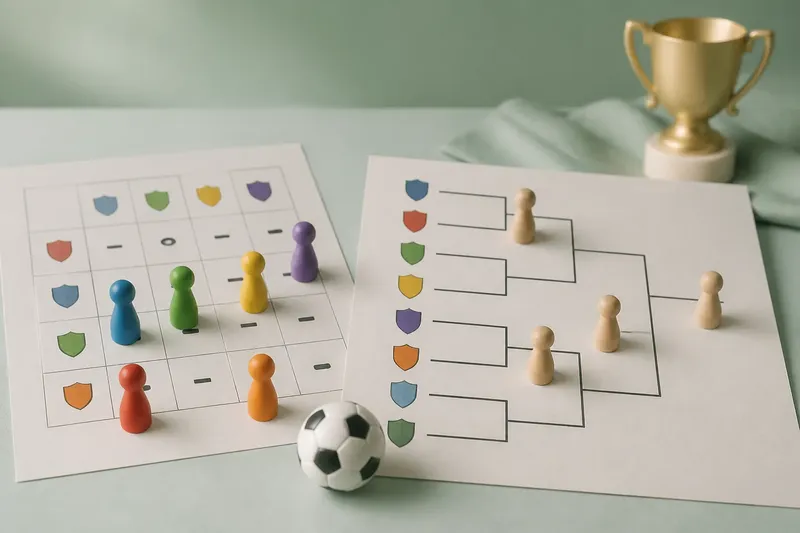
The most common mistake when comparing round-robin groups and knockout brackets is to treat them as two ways of arranging the same tournament. They ask teams to solve different problems: a group rewards performance across several opponents, while a bracket makes each result a gateway to the next round. That distinction changes what a team must protect, what it can risk, and how a viewer should read the standings.
Start with the situation you care about. If the question is which team is strongest across a stretch of matches, a group offers more evidence. If the tournament needs a direct route to one champion, a knockout bracket supplies it. Neither format removes uncertainty; each concentrates it in a different place.
How the formats work
In a round-robin group, every team plays every other team in the group, once or more depending on the competition rules. Results are converted into standings, usually using points or another published ranking system. A team’s route forward depends on its record across the group, sometimes alongside other criteria such as goal difference or head-to-head results.
A knockout bracket is an elimination tree. Teams are paired, and the winner of each tie advances while the loser leaves the competition. A tie may be one match or a set of matches; if a game ends level, the sport’s rules may use extra time, a tiebreak, a replay, or another method to decide who moves on.
Some competitions combine both structures. Teams first play in groups, then the qualifying teams enter a knockout stage. In that design, the group determines who earns a place and often where they are seeded; the bracket then decides the champion through successive elimination rounds.
Choose by tournament goal
If you want a broad comparison of every team, choose a round-robin group. Each participant faces the same set of opponents, so the final table reflects a sequence rather than one isolated result. This is useful when the purpose is to rank teams or select qualifiers, particularly when a single loss should not end a team’s campaign.
The table still needs context. A group gives each team a shared schedule, but not necessarily identical circumstances: matches may be played in a different order, venues may vary, and injuries or suspensions can shape later rounds. Tiebreak rules also matter. If two teams finish level, the competition’s stated criteria decide their order, not an assumption that one measure always comes first.
If you need a clear champion through a compact sequence, choose a knockout bracket. Every tie produces a direct consequence: advance or be eliminated. This makes the route easy to follow and can keep a tournament moving without requiring every team to meet every other one.
The trade-off is that a bracket is sensitive to a single tie. A strong team can leave after one poor performance, while a team that wins its match continues even if its overall level is less consistent. That is not a flaw if the competition values decisive head-to-head contests; it is simply what the format rewards.
If both goals matter, use a group-to-bracket format. The group stage gives teams repeated chances to establish themselves, and the elimination stage gives the event a decisive finish. This works when organizers want both a meaningful comparison and a clear final route, though it takes more matches than a direct knockout structure.
What teams must manage
In a group, teams manage a campaign. They need enough points or ranking strength to qualify, but the best approach can depend on the table’s state and the remaining schedule. A team with matches still to play may value a draw differently from a team that must win to stay in contention. Results elsewhere can also alter the target.
That makes group play a problem of accumulated outcomes. A team may recover from an early defeat, but later matches become more consequential as the available chances shrink. Coaches and players have to balance the immediate opponent against the wider standings, while viewers can track how each result changes the qualification picture.
In a bracket, teams manage a tie. There is no later group fixture in which to repair an elimination loss, so the immediate opponent takes priority. Risk can shift during the match: a team protecting a lead may seek control and limit exposure, while a team behind may need to create chances even if doing so leaves space open.
When a bracket uses two matches per tie, the situation becomes more layered. Teams can consider the combined score, and the approach in the second match may depend on what happened in the first. The rules for resolving a tied aggregate score—such as extra time or a shootout—shape how much a team can rely on the scoreline alone.
Read the route forward
A group table tells you where teams stand now; it does not always show what they need next. Check the number of fixtures remaining, the qualification places, and the tiebreak order. A team near the top may still need a result, while a team lower down may remain able to qualify if several outcomes fall its way.
A bracket tells you who a team must beat next, but the draw can change the difficulty of the route. Look at the seedings and the bracket path rather than only the next tie. In some formats, strong teams are separated until later rounds; in others, an early draw can place them on a collision course sooner. The bracket’s layout—not a team’s name alone—shows which path is open.
Say a fictional eight-team event has two groups, with the top two in each group advancing to semifinals. Imagine North City loses its opening match but wins the next one. In the group, that recovery keeps qualification possible, and the final fixture still matters because the table records all three results. If North City reaches the semifinal, however, its next loss ends its run. The same team has first been judged across a campaign and then tested in a single elimination tie.
Questions about formats?
Does a group stage always reward the best team?
It gives each team several results to build a record, which can make the final ranking less dependent on one match. It cannot remove differences in schedule, form, or tiebreak rules, so the table should be read alongside the competition’s format.
Can a team qualify after losing?
Yes, if enough matches remain and its results still leave it above the qualification line. The answer depends on the group size, points system, tiebreak order, and other teams’ results.
Why do brackets use seeds?
Seeds place teams into particular positions in the draw, often based on a ranking or qualification result. They can shape which opponents a team might face later, but they do not decide the outcome of a tie.
What happens if a knockout match is tied?
The competition’s rules specify a method, which may include extra time, a shootout, a replay, or another tiebreak. Check the event rules for the sport and stage in question rather than assuming every knockout tie uses the same procedure.
What is not worth tracking
It is not worth treating every group permutation as settled before the relevant matches are played. A long list of hypothetical outcomes can obscure the simple question: which results are still possible, and which tiebreak applies if teams finish level? Follow those facts first, then use the table or bracket to see what changes.
Round-robin groups and knockout brackets are best understood as different answers to a scheduling question. For a ranking built from repeated meetings, the group is the better fit; for a direct elimination route, the bracket is clearer; for both, the combined format assigns each job to a separate stage. When you read a tournament, identify which stage is measuring consistency and which is demanding survival. That tells you what a team’s next result can—and cannot—change.